Buffalo, N.Y. hotel proposal delayed further

Buffalo, N.Y. Hotel Proposal Controversy
Recent Developments
  • “Old deeds threaten Buffalo, NY hotel development” — Wikinews, November 21, 2006
  • “Proposal for Buffalo, N.Y. hotel reportedly dead: parcels for sale “by owner”” — Wikinews, November 16, 2006
  • “Contract to buy properties on site of Buffalo, N.Y. hotel proposal extended” — Wikinews, October 2, 2006
  • “Court date “as needed” for lawsuit against Buffalo, N.Y. hotel proposal” — Wikinews, August 14, 2006
  • “Preliminary hearing for lawsuit against Buffalo, N.Y. hotel proposal rescheduled” — Wikinews, July 26, 2006
  • “Elmwood Village Hotel proposal in Buffalo, N.Y. withdrawn” — Wikinews, July 13, 2006
  • “Preliminary hearing against Buffalo, N.Y. hotel proposal delayed” — Wikinews, June 2, 2006
Original Story
  • “Hotel development proposal could displace Buffalo, NY business owners” — Wikinews, February 17, 2006

Friday, March 10, 2006

Buffalo, New York —The Common Council of Buffalo voted on Tuesday to send the Elmwood Village Hotel proposal “to committee for further discussion”, after citing the need for more public involvement.

The Elmwood Village Hotel is a development proposal by the Savarino Construction Services Corporation, a project designed by the architect Karl Frizlen of The Frizlen Group. The hotel would be placed on the southeast corner of Elmwood and Forest Avenues in Buffalo.

To make way for the project, at least five buildings located at 1109 to 1121 Elmwood Ave would be demolished. At least two properties on Forest Avenue could also be demolished. The Elmwood properties, according to Eva Hassett, Vice President of Savarion Construction, are “under contract”, but it is unclear if Savarino Construction actually owns the Elmwood properties. Hans Mobius, a former mayorial candidate, is still believed to be the current owner the properties. Mobius also owns 607 Forest Avenue.

The properties 605 and 607 Forest Avenue could also be included in the proposal according to Hassett.

“We would use a Special Development Plan to rezone 1119-1121 Elmwood and 605 Forest to a C-2 zoning category,” stated Hassett. It is possible that Savarino Construction may try to obtain a variance for 605 Forest, which would allow them to enforce eminent domain, should the hotel be allowed to go forward.

The building at 607 Forest was also discussed to be rezoned, but it is unclear what the plans would be for that property. During the February 28 Common Council meeting, Hassett stated that the properties 605 and 607 were “now off the agenda”.

Pano Georgiadis, owner of Pano’s Restaurant at 1081 Elmwood, owns the property at 605 Forest and attended Tuesday’s Common Council meeting.

“Having a hotel is a bright idea. We all love the idea of a hotel, but the way that it is presented, is wishful thinking. This hotel does not fit. It’s like putting two gallons of water in a gallon jug, it does not fit. At the last meeting, the architect admitted that they are planning to put the undergound parking lot and the hotel, right at the property line. If I open my window, I will be able to touch the wall, that goes fifty feet high”, said Georgiadis.

“There is a problem having a seventy-two room hotel and fifty-five parking spaces. That means that all the other cars will spill all over the neighborhood. The footprint is simply too small. If you have a bigger [parking] lot, and a smaller hotel, I will welcome a hotel. I have a parking lot at my own business, and I am chasing people all day long. Remember, the city says it has ‘zero tolerance [for illegal parking]’. Try telling that to the guy from Albany who came to see his kids, that are going to Buffalo State, who would get tickets totaling over a hundred dollars”, added Georgiadis.

The city’s Planning Board is scheduled to meet on March 14, 2006 at 9:00 a.m. about the proposal. Although a discussion will take place, no vote is expected to be taken.

At the moment, none of the properties are zoned for a hotel. Savarino Construction plans on asking for a C2 zoning permit. If that does not work, they plan to implement a new zoning plan called a “special development plan” which would allow for only a hotel on the site. That zone would not be able to be changed.

“This [project] justifies Mobius’s refusal to invest in any maitenance[sic] or improvements”, on the properties said Clarence Carnahan, a local resident. “Where were the Council persons over the years? Where were the city inspectors over the years, to make sure that he maintained and improved his properties? The government was supposed to be protecting, not being preditorial. I see a predatorial issue here when it comes to this hotel. Over the years: Why has the local government been disfunctional when it came to Mobius’s properties? Refusal to invest in improvements, doesn’t that sound like a slumlord? Maybe I am missing a point here, but what kind of messages does this send to other slumlords that havn’t[sic] been jailed or fined? It’s [the hotel] trying to be pushed through.”

Carnahan also presented signs for residents and or business owners who are opposed to the hotel, that could be placed in windows or on stakes in the yard. Some of the signs said, ‘No tell hotel’, ‘Hans off, no hotel’, ‘It takes more than a hotel to make a village’. and ‘Keep Elmwood free, no hotel’. Carnahan plans on making more signs for a protest to be held on Saturday March 18, at 2:00 p.m. (EST) on Elmwood and Forest. Some signs were given to individuals after the meeting.

“First things first, Hans is the problem, and I don’t think it has been addressed. Let’s roll back the clock on this project. What can we do with Hans? There is such thing as eminent domain, which could be of greater interest to the community, to seize the property at its lowest assessed value”, said Nancy Pollina, co-owner of Don Apparel with Patty Morris at 1119 Elmwood. “There are so many ideas that have not been explored and we are about to give this parcel away, to a big developer.”

Mobius has not returned any calls by Wikinews regarding the situation.

A freelance journalist writing for Wikinews has obtained a letter, exclusively, addressed to one of the five business owners from Hans Mobius stating:

There is a proposal to develop my property which you are currently renting. Because of opposition to this development, it does not look like it will happen. I will let you know if there any changes.

Despite the letter, there have been no plans or decisions made to end the proposal.

To date, none of the business owners or residents of 1119-1121 Elmwood have received an eviction notice.

Business owners and residents gave an indication of what they would like to see happen at the corner; a project similar to one done locally last year. There, developers renovated two buildings on Auburn and Elmwood Avenues, merging the buildings into one thus allowing for more shop space. Among some of the shops to move in after the development were Cone Five Pottery, The Ruby Slipper, and Abraham’s Jewelers. Prior to the renovation work, the left building in the picture was boarded up for several years. Many of the concerned locals would like to see a similar development on Forest and Elmwood.

Rocco Termini, a developer in Buffalo, proposed a similar design at the February 28 community meeting

In an interview after the February 28 meeting, Termini stated, “I will be willing to take a look at this myself, or I would be more than happy to be partners with Sam, Sam Savarino”, who is President and Chief Executive Officer of Savarino Construction Services Corp.

So far Savarino Construction has no plans to team up with Termini.

Retrieved from “https://en.wikinews.org/w/index.php?title=Buffalo,_N.Y._hotel_proposal_delayed_further&oldid=2584585”

Claims from British quake may run into “low tens of millions of pounds” – Insurance association reps

Thursday, February 28, 2008

Representatives from the British insurance industry have said that the cost of the earthquake which hit Britain early yesterday could be over 10 million GBP. The Association of British Insurers has said in a statement that the cost for the earthquake is “likely to run into the low tens of millions of pounds.”

The Senior claims manager at the UK bank Norwich Union has described the damage by saying that at the moment most insurance claims regarding the earthquake describe “minor damage such as tiles off roofs, breakages inside the homes and brick walls collapsing.” It has also been reported that approximately 1,200 insurance claims were made in the first twelve hours after the earthquake hit Britain.

These reports come one day after the United Kingdom was hit by a 5.2 earthquake. Tremors were reported as widespread as Edinburgh, Manchester, Sheffield, Middlesbrough, Cambridge, London, Birmingham and Southampton .

Retrieved from “https://en.wikinews.org/w/index.php?title=Claims_from_British_quake_may_run_into_%22low_tens_of_millions_of_pounds%22_-_Insurance_association_reps&oldid=4510255”

The Importance Of Exposure Levels Regarding Asbestos Related Mortality}

The Importance of Exposure Levels Regarding Asbestos Related Mortality

by

Mont Wrobleski

Some research has shown a correlation between high exposure rates to asbestos with a significant excess of cancer related deaths. Just how much impact do exposure levels really have on mortality?

One interesting study is called, Lung cancer among asbestos cement workers. A Swedish cohort study and a review. By C G Ohlson, C Hogstedt – Br J Ind Med 1985;42:397-402. Here is an excerpt: Abstract – A cohort study of 1176 Swedish asbestos cement workers did not indicate any asbestos related excess mortality. Possible explanations of the negative outcome are relatively low exposure levels and the predominant use of chrysotile in production. Such a tentative conclusion is supported by a review of five mortality studies of workers exposed to asbestos cement that report considerable differences in relative risks for lung cancer. These differences could be explained by various degrees of cumulative exposure, the amount of amphiboles in the production, and methodological shortcomings. A median exposure of 10-20 fibre-years does not seem to cause an increased risk of lung cancer, particularly when only chrysotile is used.

A second study is called, A study of the mortality of workers in an asbestos factory by M. L. Newhouse Br J Ind Med 1969;26:294-301. Here is an excerpt: Abstract – A study of the mortality of workers in an asbestos factory. A cohort study of over 4,500 male workers employed at an asbestos factory making both textiles and insulation materials is described. The main analysis of the mortality of workers employed between April 1, 1933, the date of the implementation of the Asbestos Regulations, and May 1, 1964. The analysis was made in relation to job, length of exposure, and length of follow-up after first exposure. There was no significant difference between the number of deaths occurring in the factory population and the national figures, until an interval of 16 years or longer had elapsed from first exposure in the factory. There were 1,160 men who fulfilled this criterion. In this group there was no excess mortality among those who worked in jobs where exposure was low or moderate, but among those with jobs which entailed heavy exposure there was a significant excess of deaths from cancer of the lung and pleura, and cancer of other sites, in men with a total period of employment in the factory of less than two years, as well as with those who worked for longer. Excess mortality from respiratory disease was observed only among severely exposed workers with long service.

A third study is called, The effects of long-term ingestion of asbestos on the colon of F344 rats by Kelley J. Donham, MS, DVM, John W. Berg, MD, Loren A. Will, DVM, MPh, Joel R. Leininger, DVM, PhD, – Department of Preventive Medicine and Environmental Health, College of Medicine, University of Iowa, Iowa City, Iowa – National Large Bowel Cancer Project Here is an excerpt: Abstract – Weanling F344 rats, which were fed a diet containing 10% chrysotile (B), were studied over their lifetime to determine the effects of ingested asbestos on the colon. Control groups consisted of rats fed a diet containing a 10% nonnutritive cellulose or a standard laboratory rat diet. The pathological findings in the colons of 501 rats (189 on asbestos diet, 197 on fiber control diet, and 115 on standard control diet), are reported here. Epithelial tumors of the colon (eight adenocarcinomas and one adenoma) were found in nine of the rats on study. Four of the tumors were in asbestos-fed rats, two tumors were found in the non-nutritive cellulose controls, and three tumors were found in the standard laboratory rat diet controls. The probability (based on actuarial analysis) of developing adenoma or adenocarcinomas during the 32 months of the study were 7.4% for the asbestos-fed group, 3.5% for the fiber control diet and 4.0% on the standard control diet. In addition, one malignant mesothelioma of the type induced by intraperitoneally administered asbestos was found in the asbestos-fed group. Non-neoplastic lesions of the colon were also evaluated. The cumulative risk for development of any colon-associated lesion (non-neoplastic plus neoplastic lesions) was greatest for asbestos-fed rats (17.9%), compared to 13.6% for those fed the fiber control diet and 8.2% for those fed the standard control diet. The colon tissue levels of adenosine, 3-5-cyclic monophosphate (cAMP) were significantly lower in the animals fed asbestos compared to the control diets. Chrysotile fibers were seen by electronmicroscopy (e.m.) in six of ten ashed colon specimens of rats fed the asbestos diet. Although the differences in numbers of tumors between the animals fed asbestos and the controls were not statistically significant at the 5% level, we felt that the combination of observations including 1) evidence of increased probability of asbestos-fed animals to develop colon lesions in general; 2) evidence of a special type of mesothelioma in rats fed asbestos; 3) evidence for a cell regulator defect (lowered cAMP levels) in colon tissues of animals fed asbestos; and 4) evidence for asbestos fiber penetration of the colonic mucosa (e.m. studies) suggest that ingested asbestos is not inert in the colon.

If you found any of these excerpts interesting, please read the studies in their entirety. We all owe a debt of gratitude to these researchers.

Monty Wrobleski is the author of this article on

Texas Mesothelioma Attorney

,

Mesothelioma Lawyer Texas

Article Source:

The Importance of Exposure Levels Regarding Asbestos Related Mortality}

Kansas library discusses Wikipedia

Tuesday, February 5, 2008

This article mentions the Wikimedia Foundation, one of its projects, or people related to it. Wikinews is a project of the Wikimedia Foundation.

A diverse group of approximately 25 people gathered at the Johnson County Library on Monday to participate in reference librarian Scott Vieira’s class, Wikiwhatia? Wikipedia.

Scott opened the session by sharing a disparaging quote from Robert McHenry (former editor-in-chief of Encyclopedia Britannica) comparing Wikipedia to a public restroom. He then shared a quote from Andrew Keen, author of The Cult of the Amateur, in which he stated Wikipedia is the blind leading the blind. Scott shared Wikipedia usage data from a 2007 Pew Internet study showing 36% of adults have consulted Wikipedia and that that Wikipedia receives 10,000-30,000 searches per second. Scott also pointed out that Wikipedia now has over two million articles in English alone (over nine million articles in 250 languages). So there is a discrepancy here, lots of critics and lots of use.

Scott then shared some historical information in order to provide a context for understanding Wikipedia. This included some important names and dates in the history of encyclopedias… including Pliny the Elder (23-79 C.E.) who published 37 Volumes of Natural History, and Joachim Sterck van Ringelbergh (c. 1499-1556) who first used the term encyclopedia, and then d’Alembert and Diderot who published 17 volumes of their French Encyclopedia from 1751-1765. Encyclopedia Britannica was first published in Scotland in serial format 1768-1771.

Scott also discussed more recent history, sharing a photo of Ward Cunningham –who is credited with being the inventor of wiki software. Wikipedia was founded on Jan 15, 2001 by Larry Sanger and Jimmy Wales. Sanger left Wikipedia in 2002 and founded Citizendium in 2007 a complementary project which now has 4500 articles.

After the historical perspective, the class moved into using Wikipedia. Everyone in the audience had used Wikipedia. The class explored the content of Wikipedia, realising there is a whole lot going on. Scott demonstrated that the article about “frogs” for example, is semi-protected. The “history of science” article was examined, including the history of changes. Discussion covered how people contribute, who contributes and edits. The group also talked about Wikipedia bots, which aid in routine tasks in a semi-automated or automated fashion.

A discussion about teachers, school media specialists and students regarding their use of Wikipedia ensued. Some teachers and school media specialists are negative about Wikipedia, but Scott’s hope is that they will use it to start a discussion about the need to evaluate and critically think about information (even when it’s from more traditionally reviewed and edited sources).

An unanswered question from an audience member was, “What was the first Wikipedia article?”

Discussion topics from Scott to audience were as follows:

  • Do you think Wikipedia is less accurate than published resources and how important is that accuracy to you?
  • How do we determine authority on a subject? How important is it that an article be written by an expert? How is Wikipedia changing our idea of what an authority is?
  • Currency – the ability to publish immediately – what are the advantages and what are the disadvantages?
  • What do we think about the content selection in Wikipedia?
  • Should Wikipedia be used by librarians?
  • What do you think about the future of Wikipedia?
Retrieved from “https://en.wikinews.org/w/index.php?title=Kansas_library_discusses_Wikipedia&oldid=589054”

One dead after bus and bicycle crash in Hampshire, England

Monday, July 19, 2010

A person has died after being involved in a collision between a bus and a bicycle in Hampshire in the south of England, United Kingdom. The woman, who has not been publicly identified, was cycling in the seaside resort of Southsea when a number 700 Stagecoach single-decker bus, which was travelling from Brighton to Southsea, collided with her bicycle at approximately 1315 BST (1215 UTC) on Saturday. A helicopter transported the woman to Southampton General Hospital, where she died at approximately 1630 BST (1530 UTC) on the same day.

None of the occupants of the bus were injured. The 53-year-old bus driver has now been arrested on suspicion of causing death by dangerous driving. Hampshire Constabulary is requesting any witnesses to the accident to contact them. PC Phil Hunt also mentioned: “We are also trying to trace the passengers, who left the scene before we could speak to them.”

The road traffic accident occurred in an area where Portsmouth City Council had been intending to place a new cycle route, but the plans to do so were cancelled last week. The plans, which would have cost £250,000 (US$382,373, €296,481, A$441,126), were said to have been cancelled due to financial difficulties.

Portsmouth Cycle Forum vice chair Jon Spencer has stated: “Sadly, we’ve had to wait less than a week for a brutal illustration of why we need this cycle route.” The vice chair of the local cycling group continued: “The road at Clarence Pier is very narrow, very crowded by parked cars and very busy. It is the most popular part of the seafront but at the moment it is a no-go area for cyclists. The city council are obviously happy for this to remain the case.”

This terrible accident is yet another reminder that large vehicles, busy traffic and cyclists are not a happy mix.

John Holland, the chair of the Forum, wrote on PompeyBUG, a local cycling Internet forum: “Portsmouth Cycle Forum is very sad to learn of the death in a road accident of a woman cyclist at Clarence Esplanade on Saturday 17 July. Our thoughts lie with her family and friends to whom send our deepest condolences. The cyclist was involved in collision with a bus in the vicinity of Pier Road and Clarence Esplanade, close to Clarence Pier.

“This terrible accident is yet another reminder that large vehicles, busy traffic and cyclists are not a happy mix. Whilst it will be some time before the details are made public, we urge the Portsmouth City Council to press ahead with making this section of our seafront much safer and calmer for all. Almost exactly one year ago, a cyclist was seriously injured Clarence Esplanade when a car reversed blindly from a parking bay into the road.

“Portsmouth City Council is on the verge of postponing Phase 2 of the Southsea Seafront Cycle Route. Had this been in place yesterday then this awful incident might have been avoided. We urge councillors to think again. A safe and segregated cycle route can be built – one which doesn’t loose any car parking, one which doesn’t stop people looking out to sea from their cars, one which doesn’t involve cycling on the promenade. We will be pushing hard for this – we don’t want any more injuries and fatalities on our seafront roads.”

Retrieved from “https://en.wikinews.org/w/index.php?title=One_dead_after_bus_and_bicycle_crash_in_Hampshire,_England&oldid=3439807”

Bush may deploy military if bird flu breaks out

Tuesday, October 4, 2005

President Bush has asked Congress to discuss the option of allowing him to deploy military resources if avian flu breaks out in America.

“I’m concerned about what an avian flu outbreak could mean for the United States and the world,” said the president in a conference today. The president also expressed concern that local response would be slow, given the precedent provided by the recent gulf coast hurricane disasters, the aftermath of which has triggered widespread criticism for what many view as instances of long-delayed and inadequate delivery on the part of the white house and congress. “I want there to be a robust discussion about the best way for the federal government, in certain extreme circumstances, to be able to rally assets for the good of the people,” the President said previously.

Avian flu is not currently able to easily pass from human to human, limiting epidemics. The president and others warn that the virus may mutate into a form that more easily spreads through social contact.

Retrieved from “https://en.wikinews.org/w/index.php?title=Bush_may_deploy_military_if_bird_flu_breaks_out&oldid=2257790”

About Freebie Websites

Click Here For More Specific Information On:

Freebie websites are functioning in the United Kingdom for about 15 years. Prior to that people used to associate with US based freebie websites. But the number of consumers who actively pursued the membership was limited. When UK based portals started to function, system became popular. Initial responses were not very much encouraging, but gradually the situation improved. The number of consumers participating in the events increased rapidly. There was substantial increase in the number of freebie websites also. The success of the first few freebie websites inspired many others to establish similar portals. Companies and other establishments liberally offered freebies, free stuff and gifts through these websites. As far as consumers are concerned, the initial inertia was a short time phenomenon. Later the freebie websites received overwhelming support from the consumers and in a couple of years the practice of frequenting them became habitual to many. Some of the freebie websites are now highly patronized. A particular one received responses from about a million visitors in three months.

As already mentioned, there are different themes that are dealt with by these websites. Large number of freebie websites deal with industrial products and services. The sponsors or advertisers bestow the consumers lavishly with free samples and gifts. New products are being introduced. Services like insurance, travel and entertainment are handled by several freebie websites. Advertisements regarding marriage, health and family welfare are other examples. They attract numerous consumers. Baby foods, toys and infant related products receive much attention and support. Free games, free DVD trials, free antivirus software, free texts from the web and free GYM passes are offered to the members by the websites. Free mobile phones and free iPods are among expensive gifts offered to the consumers. People received laptops and office software as gifts much to their excitement and happiness.

[youtube]http://www.youtube.com/watch?v=SJdDHyfaLoo[/youtube]

It is not only goods but also essential services like information about sale of used items or about recycling of unused appliances are offered to the members. When the number of freebie websites and the number of participating members increased rapidly, it became necessary for people to surf the internet extensively to locate desired websites which cater their tastes ideas or requirements. Special websites offered consumers lists of all leading freebie websites with details of offers and their durations. Such websites will provide their subscribers with all necessary particulars about active and popular freebie websites. Consumers subscribed for newsletters to secure information about various freebie websites. Another venture is the establishment of websites which conduct surveys. People who provide valuable information to such surveyors will be compensated liberally. Freebie directories provided people with rich information about various offers. Freebie mailing lists reached subscribers every weekend. Freebie forums to connect and facilitate interactions between participating consumers are yet another venture. Freebie hunters wanted their views to be heard.

Websites which function as the mouthpieces of freebie hunters aired their views. Consumers want the freebies, gifts etc to be delivered to them free. Some of the freebie websites are levying shipping charges from the beneficiaries of free gifts. Consumers are not very happy about the practice. According to them levy of shipping charges is tantamount to hidden charges.

Article Source: sooperarticles.com/internet-articles/web-development-articles/about-freebie-websites-618158.html

About Author:

Find out Freebies,free stuffs,free samples also get discount vouchers and special offers at freeinuk website.Author: Henry Joe

The Deadliest Fall

18 December 2004

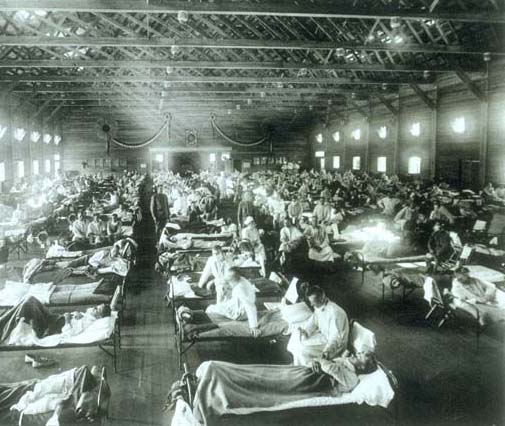
Emergency hospital during 1918 influenza epidemic, Camp Funston, Kansas (source: National Museum of Health and Medicine, AFIP).

A bout of the flu can be mild. In young, healthy adults, many infections pass unnoticed. But sometimes the influenza virus evolves into a strain that decimates its victims. The worst known strain swept the world in the Fall of 1918, infecting 500-1000 million and killing 40-100 million, about 2-5% of people.

There are several theories about where the pandemic began, but the likeliest origin was in Haskell County, Kansas, in the United States. People in the sparsely populated county, where farmers raised pigs, poultry, cattle, and grain, began suffering from influenza in late January 1918. Unusually for flu, it was young, healthy adults who were hardest hit. Victims fell ill suddenly, many progressing to pneumonia and dying, often within days. Within weeks, however, the epidemic ended. The natural geographic isolation of this community normally might have contained the fatal flu in a sort of unintentional quarantine, but the First World War intervened. Men were uprooted from their home towns and congregated in huge numbers in army camps for training and then shipping out to other camps or to fight in Europe. The destination for men from Haskell County was Camp Funston, part of Fort Riley, Kansas, where the first influenza case was reported in early March. As soldiers moved among camps, the virus spread. Within two months, the epidemic spread to most of the army camps and most of the largest cities in the United States. As American soldiers went to France, so did the virus, spreading first from the port of Brest.

The flu then spread worldwide. The pandemic reached its height in the Fall of 1918. Spain was affected early, and because Spain was not fighting in the World War, there was no wartime censorship, and news of the outbreak became widely known, leading to the flu being called the Spanish Flu in many countries. In Spain, however, it was called French Flu or the Naples Soldier. In India, about 12 million people died of flu. In some US cities, people died so quickly that morticians couldn’t cope with the bodies. According to Jessie Lee Brown Foveaux, who worked in the Fort Riley laundry during the epidemic: “They were piling them up in a warehouse until they could get coffins for them.”

The disease started with cough, then headache. Temperature, breathing and heart rate increased rapidly. In the worst cases, pneumonia came next, the lungs filling with liquid, drowning the patients and turning them blue from lack of air. Patients bled from every orifice: mouths, noses, ears, eyes. Those who survived often suffered temporary or permanent brain damage. Several million developed encephalitis lethargica, in which victims were trapped in a permanent sleeplike and rigid state, as portrayed in the 1990 movie “Awakenings.” In others, normal thought processes were impaired. During negotiations to end World War I, US President Woodrow Wilson was struck with flu, and people around him noted that his mental abilities never fully recovered. The French leader George Clemenceau had wanted harsher punishment of Germany than Wilson had desired. Clemenceau may have convinced Wilson in his weakened state to accept such harsh terms, which may have been one of the factors causing World War II.

Since flu is highly contagious early in the illness, even before symptoms appear, strict quarantine may be necessary to stop its spread during an epidemic. Australia kept its 1918 flu death rate relatively low by enforcing quarantines. However, in many parts of the world, public health officials hesitated to impose such measures, giving the disease time to gain a foothold. In the US city of Philadelphia, a rally of half a million people was planned in September 1918 to sell bonds to fund the war, at just the time when the flu started to infect residents. Although doctors warned the public health director to cancel the rally, he wanted to meet the city’s quota to raise money for the war and refused to cancel the event. Within days after the rally, half a million city residents caught the flu.

Why was the 1918 flu so deadly? The influenza virus wasn’t preserved at the time of the outbreak, at least on purpose. But in the late 1990s researchers Ann Reid, Jeffery K. Taubenberger, and their colleagues extracted and sequenced the genetic material of the virus, RNA, from tissue of victims who died in the pandemic. They used bits of lung that were preserved in formalin from victims on army bases or from victims buried in permafrost in the Alaskan village of Brevig Mission, where flu killed 85% of adults. Comparisons with known flu viruses in humans, pigs, and birds suggest that some genes of the 1918 virus came from birds or an unknown animal source. Other scientists then were able to show that the amino acid sequence of hemagglutinin protein from the 1918 virus had several changes from other flu viruses that may have helped it to easily bind and invade human cells, and that made the virus look different enough from earlier flu virus strains that people had no immunity.

The possibility exists that another flu pandemic will sweep the world like the one in 1918. In 2004, an H5N1 influenza virus has killed millions of birds and at least 30 people in southeast Asia. So far this virus strain has not evolved the ability to pass directly from human to human, but that possibility becomes more likely as the bird flu pandemic continues and humans remain in contact with chickens, ducks, and other birds. The virus has killed two-thirds of people reported to be infected. Dr. Tim Uyeki, an epidemiologist for the US Centers for Disease Control, says, “you have the ingredients in Asia right now for a public health disaster.”

But since sequences of this bird flu virus are known, it may be possible to develop a vaccine or set of vaccines to protect against it. At a special meeting of influenza experts on November 11th and 12th, World Health Organization influenza program chief Klaus Stohr said, “It is not only possible, but also important, that influenza pandemic vaccines be made available… and there’s a shared responsibility needed to make that happen…. We have a huge window of opportunity now.”

Retrieved from “https://en.wikinews.org/w/index.php?title=The_Deadliest_Fall&oldid=2526338”

Washington D.C. football team replaces controversial name with “Commanders”

Friday, February 4, 2022

The American football team based in Washington, D.C., announced Wednesday on the Today Show it would adopt the new name the Washington Commanders.

The team, which plays in the National Football League (NFL), had previously been called the Washington Redskins.

For years, Native American organizations had argued it is offensive for sports teams to call themselves Indians. The Washington team drew more criticism than most, because unlike “Indians” or “braves,” the word “redskin” is specifically, as Ray Halbritter of Oneida Nation Enterprises called it, “a dictionary-defined slur.”

On Wednesday, team president Jason Wright told viewers the new name “embodies the values of service and leadership that characterizes the DMV [D.C., Maryland, Virginia region].”

Current and former players Jonathan Allen and Gary Clark praised the new uniforms, which feature a prominent letter “W.” Allen said that although the name did not have meaning or history, the experience and atmosphere of seeing players in their new uniforms would soon bring enthusiasm from fans.

For a long time, team owner Daniel Snyder resisted changing the name, once threatening to “put it in all caps.” However, in June 2020, 87 sponsors that pay hundreds of millions of dollars to affiliate with the team, including FedEx, Nike, and Pepsi, wrote a letter to the team management asking the name be changed. The team had also faced increasing complaints the old name was insulting to Native Americans. The team hired John Wright, who consulted with fans, a former player, and Native Americans to find a new name. Fans liked variations of “Red Wolves,” but too many other teams had already trademarked and copyrighted similar names and imagery.

Reactions from Native American voices were mixed.

Crystal Echo Hawk of IllumiNative said the team had an opportunity to “put a horrible chapter to rest,” adding: “There’s still a lot of healing that needs to happen, so I don’t think the team’s work in regards to reconciliation and healing is over.”

Fawn Sharp of the National Congress of American Indians (NCAI) said team management had not done enough to acknowledge the harm done by the former name: “Without an apology, without any measure of accountability, and without fulfilling the honored commitments they made to tribal nations in 2020 to right this wrong, the NFL and Snyder are simply ‘Commanding’ a continued course of open, intentional and profit-driven racism and erasure.”

About one thousand sports teams in the United States are named after Native Americans in some way, down from about three thousand in the 1990s. The American Indian Movement and NCAI, among other organizations, have advocated for these teams to adopt non-Native American names and mascots.

Retrieved from “https://en.wikinews.org/w/index.php?title=Washington_D.C._football_team_replaces_controversial_name_with_%22Commanders%22&oldid=4662227”

Seeds placed in Norwegian vault as agricultural ‘insurance policy’

Wednesday, February 27, 2008

The Svalbard Global Seed Vault, a vault containing millions of seeds from all over the world, saw its first deposits on Tuesday. Located 800 kilometers from the North Pole on the Norwegian island of Spitsbergen, the vault has been referred to by European Commission president José Manuel Barroso as a “frozen Garden of Eden“. It is intended to preserve crop supplies and secure biological diversity in the event of a worldwide disaster.

“The opening of the seed vault marks a historic turning point in safeguarding the world’s crop diversity,” said Cary Fowler, executive director of the Global Crop Diversity Trust which is in charge of collecting the seed samples. The Norwegian government, who owns the bank, built it at a cost of $9.1 million.

At the opening ceremony, 100 million seeds from 268,000 samples were placed inside the vault, where there is room for over 2 billion seeds. Each of the samples originated from a different farm or field, in order to best ensure biological diversity. These crop seeds included such staples as rice, potatoes, barley, lettuce, maize, sorghum, and wheat. No genetically modified crops were included. (Beyond politics they are generally sterile so of no use.)

It is very important for Africa to store seeds here because anything can happen to our national seed banks.

Constructed deep inside a mountain and protected by concrete walls, the “doomsday vault” is designed to withstand earthquakes, nuclear warfare, and floods resulting from global warming. Norwegian Prime Minister Jens Stoltenberg called it an “insurance policy” against such threats.

With air-conditioned temperatures of -18 degrees Celsius, experts say the seeds could last for an entire millennium. Some crops will be able to last longer, like sorghum, which the Global Crop Diversity Trust says can last almost 20 millenniums. Even if the refrigeration system fails, the vaults are expected to stay frozen for 200 years.

The Prime Minister said, “With climate change and other forces threatening the diversity of life that sustains our planet, Norway is proud to be playing a central role in creating a facility capable of protecting what are not just seeds, but the fundamental building blocks of human civilization.” Stoltenberg, along with Kenyan Nobel Peace Prize laureate Wangari Maathai, made the first deposit of rice to the vault.

“It is very important for Africa to store seeds here because anything can happen to our national seed banks,” Maathai said. The vault will operate as a bank, allowing countries to use their deposited seeds free of charge. It will also serve as a backup to the thousands of other seed banks around the world.

“Crop diversity will soon prove to be our most potent and indispensable resource for addressing climate change, water and energy supply constraints and for meeting the food needs of a growing population,” Cary Fowler said.

Retrieved from “https://en.wikinews.org/w/index.php?title=Seeds_placed_in_Norwegian_vault_as_agricultural_%27insurance_policy%27&oldid=1971319”